Showing posts with label reservoir engineering. Show all posts

Tuesday, July 30, 2019

Petroleum Exploration- Innovation R&D- Airborne Seismic

An integrated geophysics and logistics R&D project are called METIS, Multiphysics Exploration Technology Integrated System.

METIS aims to improve the quality and speed of data acquisition through real-time quality control and processing, while at the same time slashing both the cost and HSE risks of operations.
“Tomorrow’s most promising onshore oil and gas exploration acreages are located in foothills, yet these areas have been underexplored as traditional exploration methods are not suitable to deal with these complex environments
Imagine a swarm of drones hovering over a remote tropical forest dropping what looks like large darts. The darts are actually seismic receivers delivered from the air. They are part of a project to rethink how surveys are done in remote spots where the jagged landscape limits movement on the ground.
The goal is to find ways to sharply reduce both the cost and the environmental impact of gathering the volumes of data needed to illuminate oil and gas deposits in complex, hard-to-image formations.
Rather than hacking paths through dense forests to set out lines of seismic receivers, they are building and testing a system using drones to drop thousands of receivers that will biodegrade after the survey.

A radio communication system developed by Wireless Seismic, called the Downfall Air Receiver Technology (DART) links the dropped DARTs to a control and processing center that monitors the quality of incoming data and makes changes if there are problems.

FRONTIER TECHNOLOGY

The current version of the system will be tested later this year when a single drone will be used to drop 100 of the DARTs over a 0.2-km2 area. That will show if a new carrousel on the underside of the drone, which carries four DARTS, can drop them one at a time at locations along its route.
They will also see how reliably the DARTS can record and transmit data. This will require landing them in a nearly vertical position for reliable data gathering and then transmitting the information to a central processing center.

Total is building toward an “industrial-scale” pilot project, which it hopes will be ready in 2021, to deploy 40,000 to 50,000 DARTs over a 100-km2 area.

1.dart-shaped


This dart-shaped seismic receiver picks up data and sends them to a central processing center during a seismic survey.


AIRBORNE DELIVERY


Automated drone flights carpeting the forest floor are just one of the aerial departures from conventional ground-based, data-acquisition methods.
To move in heavy loads without a road or runway, Flying Whales, to develop a new airship, called the HA2t. It is designed to be packed inside a standard shipping container for rapid delivery around the world.

2.airship


This airship, called the HA2t, can lift 2 tons into remote areas, and can be shipped in a standard cargo container.


Before any heavy equipment arrives, data from satellite imaging and aircraft surveys using a variety of methods—hyperspectral, radar, and LiDAR (Light Detection and Ranging)—are used to create detailed maps of the surface and near-surface. Those will be used to choose the best locations for seismic sound sources and receivers, and plan how best to manage the operation.

3.Lidar data


LiDAR data are used to map the contours of the survey area during the planning process.


Technically speaking, good imaging of complex rock requires high trace density. That is a measure of the quality of the subsurface illumination, which is a function of the number of seismic sources and receivers. More receivers can compensate for fewer sound sources, and vice versa.
And they must be evenly distributed to ensure the entire area is covered. Adding receivers is likely to be the best option for increasing the trace density.
“By adopting a carpet receiver approach, where receiver stations are located on average 50 m in all directions, METIS reduces the dense source requirement” by using more receivers.

Credits: Oil and gas portal

Tuesday, July 23, 2019

Petroleum - Downstream - Refining Cycles

If you are interested in presenting a talk at the conference ( World Congress on Petrochemistry and Chemical Engineering ), please submit a copy of your abstract here Abstract Submission


SIMPLE CYCLE REFINERIES


Simple cycle refineries (Hydroskimming) are traditionally equipped with crude oil distillation plants, desulphurization units for distillates, and with units to increase the octane number of gasoline.


The hydrogen for hydrodesulfurization is supplied by the reforming units. More recently, the reform units have been accompanied by units for the isomerization of the C5-C6 cut.

Diagram of a Simple Cycle (Hydroskimming) Refinery

Diagram of a Simple Cycle (Hydroskimming) Refinery


THERMAL CONVERSION CYCLE


In addition to the units in the hydroskimming scheme, the thermal conversion cycle also includes visbreaking units (plus thermal cracking) or cokers; these represented the first generation of conversion processes.

Thermal Conversion Cycle with Visbreaking and Thermal Cracking

Thermal Conversion Cycle with Visbreaking and Thermal Cracking


Visbreaking (VB) and coking have always been relatively important, given their ability to treat the residues of distillation atmospheric and vacuum in a relatively simple and economical way. 

Coking, in particular, may also represent the basic process in a deep conversion refinery if a use is found for the coke produced (combustion, sale or gasification). 

Yields, especially in the case of visbreaking, are not high; the same is true of the quality of the products. 

However, there is an increase in middle distillates (in the case of VB) or light products in general (in the case of coking), and this improves the refinery’s operational flexibility.

TCC with coking

Thermal Conversion Cycle with Coking


However, this cycle is unable, at least in its simplest form, to meet the quality and environmental requirements of a modern industrialized country.


CATALYTIC CONVERSION CYCLE


Catalytic conversion refineries are equipped, in addition to the other units, with more traditional conversion plants, especially those for catalytic cracking and/or hydrocracking .

Since the beginning, catalytic cracking has been more popular in the American refining system than in the European. Often, the catalytic cracker is followed by an alkylation plant which uses the gaseous by-products of FCC.

TCC with FCC and alky

Catalytic conversion cycle with FCC and alkylation


Hydrocracking, which necessarily requires the presence of purpose-built plants for the production of hydrogen (steam reforming), became widespread later and represents the basis of many modern refining cycles.

CCC with hydrocraking

Catalytic conversion cycle with hydrocracking


Credits: Oil and Gas portal

Thursday, June 13, 2019

Petroleum - Upstream - Basic Concept

Upstream is a term used in the oil industry which refers to the searching for, the recovery and production of crude oil and natural gas.

The upstream sector includes

  • Exploration – the searching for potential onshore or offshore oil and gas reservoirs, and the drilling of exploratory wells
  • Production and maintenance of wells and facilities to recover and bring the crude oil and/or raw natural gas to the surface plant and to process the produced hydrocarbons.

Figura1


The upstream sector in the context of the petroleum industry cycle

Within the upstream sector, a typical oil and gas operating cycle sees several and different phases that aim to target varied goals using specialized technologies.

A schematic representation of the field cycle and the activities generally carried out in each phase is shown in the figure below:

Figura2


The oil and gas operating cycle and activities


The term “Petroleum” refers to both crude oil and natural gas.

These are mixtures of hydrocarbons which are molecules, in various shapes and sizes, of hydrogen and carbon atoms, and different mixtures of hydrocarbons have different uses and different economic values.


Figura3


Basic hydrocarbon structures


Crude oil refers to hydrocarbon mixtures produced from underground reservoirs that are liquid at normal atmospheric pressure and temperature.

Natural gas refers to hydrocarbon mixtures that are gaseous, at normal atmospheric pressure and temperature – the gas mixtures consist largely of methane – the smallest natural hydrocarbon molecule (CH4).

The extremely variable compositional complexity of petroleum reveals the joint effects of all processes involved in the origin of petroleum accumulations and their history during the geological time.


Figura4


The process of origin of oil and gas


Hydrocarbon reservoirs (porous and permeable host rocks) are thousands of feet below the surface, and oil and gas accumulations form in sedimentary basins if some geological conditions (Petroleum System) are met:
  • Existence of source rocks which generate petroleum under particular subsurface temperature conditions
  • Expulsion of petroleum from the source and subsequent migration
  • The occurrence of reservoir rocks of sufficient porosity and permeability allowing the flow of petroleum through the pore system
  • Configurations and arrangement of rock layers to form traps
  • Presence of impermeable layers (cap rocks) to confine petroleum accumulations in place
  • Correct timing with respect to the sequence by which all the above processes have occurred during the history of a sedimentary basin
  • Advantageous conditions for the preservation of petroleum accumulation during the geologic time

Figura5

Common types of petroleum traps


Credits: Oil and Gas portal

Thursday, June 6, 2019

INTRODUCTION TO OIL & GAS WELL DRILLING

The term drilling indicates the whole complex of operations necessary to construct wells of the circular section applying excavation techniques.


To drill a well it is necessary to carry out simultaneously the following actions (drilling process):
  • to overcome the resistance of the rock, crushing it into small particles measuring just a few mm;
  • to remove the rock particles, while still acting on fresh material;
  • to maintain the stability of the walls of the hole;
  • to prevent the fluids contained in the drilled formations from entering the well.
This can be achieved by using rotary drilling rigs which are the ones operating today in the field of hydrocarbons exploration and production.

The drilling rigs are complexes of mobile equipment which can be moved (onshore and offshore) from one drill site to another, drilling a series of wells.

In rotary drilling, the rock is bored using a cutting tool called the bit, which is rotated and simultaneously forced against the rock at the bottom of the hole by a drill string consisting of hollow steel pipes of circular section screwed together.


Immagine1

                      Land Drilling Rig


After having drilled a certain length of the hole, in order to guarantee its stability it has to be cased with steel pipes, called casings, joined together by threaded sleeves.

The space between the casing and the hole is then filled with a cement slurry to ensure a hydraulic and mechanical seal.

The final depth of the well is accomplished by drilling holes of decreasing diameter, successively protected by casings, likewise of decreasing diameter, producing a structure made up of concentric tubular elements.


Image result for oil drilling process animation

The Drilling Process

Planning the drilling of a well


The planning of a well is a fundamental part of the drilling process – it is the basis for making all the important technical choices, for assessing the costs and organizing the actual construction of the well in the most efficient way.

The well planning starts the moment when the interpretation of the seismic data and the reconstruction of the geology of the area reveal the presence of a structure favorable to the accumulation of hydrocarbons.


Immagine3

Overview of the well planning process


Choice of the rig, wellhead, and BOP


The casing levels, the diameters, and weight of the strings, the pressures and temperatures concerned, and the volumes of drilling mud to be used, are all aspects participating in determining the choice of rig type, blowout prevention systems (BOP, choke manifold, hydraulic circuit) and wellheads.

The choice of the rig is closely bound up with the depth it is wished to reach and with the weight of the strings concerned.

According to the weights of the strings to be handled, rigs are used that have different characteristics, and what is of basic importance is the strength of the whole assembly, (traveling block, crown block, hook and derrick floor) from which the string hangs while being lowered into the well.

In the offshore activity, the choice of the rig is determined, not only by the weight of the strings but also by the depth of the water in the area of operations.

Drilling rigs installed on offshore vessels or platforms are built to reach the maximum possible depths and have all the material and equipment necessary for drilling on board.

The composition of the wellhead depends on the pressures that can be reached during the various working phases – both drilling and production – and on the diameters of the strings to be lowered into the well.


Well abandonment


If, when drilling has been completed, the well is productive hydrocarbons, a start is made on all those operations that will ensure its economically advantageous working, whereas if, on the contrary, it should prove to be barren or in any case not economically exploitable, it will be shut down.

Well shutdown entails the restoring of the initial conditions of the section of the well not lined and possibly also the lined part if the separation of the permeable levels of different pressure is not assured.

The purpose of these measures is to prevent the transfer of fluids from one level to the other.

The final shutdown of a well must satisfy not only the requirements set out in the engineering best practices fixed by the operator but must also respond to all the requisites of law aimed at safeguarding the environment and the safety of the people living in the vicinity of abandoned wells.


Immagine6

Well Plug & Abandonment

Tuesday, June 4, 2019

ENVIRONMENTAL IMPACT OF PETROLEUM AND NATURAL GAS

The secret to fossil fuels ability to produce energy is that they contain a large amount of carbon. This carbon is left over from living matter — primarily plants — that lived millions of years ago. Oil and natural gas are usually the results of lots of biological matter that settles to the seafloor, where the hydrocarbons(molecules of hydrogen and carbon), including methane gas, become trapped in rocks.

Petroleum sources are usually small pockets of liquid or gas trapped within rock layers deep underground (often under the seafloor). Extracted crude oil is refined and used to manufacture gasoline (used in transportation) and petrochemicals (used in the production of plastics, pharmaceuticals, and cleaning products).


1. THE ENVIRONMENTAL IMPACT OF DRILLING FOR OIL


Oil companies pump liquid oil out of the ground by using drilling rigs and wells that access the pockets of oil resources. The oil fills the rock layers the way water fills a sponge — spreading throughout open spaces — instead of existing as a giant pool of liquid.

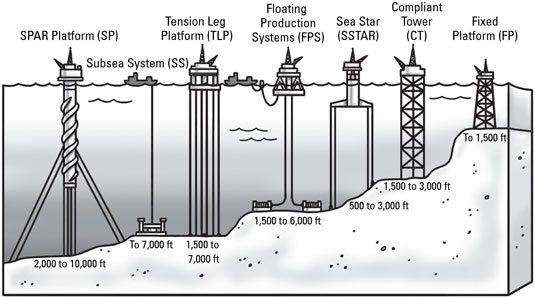
This arrangement means that to pump out all the oil, drillers have to extend or relocate the wells after the immediate area has been emptied. Oil drilling rigs set on platforms in the ocean to access oil reserves below the seafloor must, therefore, employ a series of more technically complex drill rigs built to access oil reserves in deeper water.

The below figure illustrates some of the most commonly used ocean drilling rigs and platforms and the water depths they’re most suited for.


[Credit: Illustration by Lisa Reed]


2. THE ENVIRONMENTAL IMPACT OF FRACKING FOR NATURAL GAS


Natural gas is a relatively clean-burning fuel source — it produces approximately half the CO2 emissions that coal burning produces — so the demand for natural gas has increased in the last few decades as concerns grow about carbon emissions and global warming.


Hydraulic fracturing flat schematic vector illustration. Fracking process with machinery equipment, drilling rig and gas rich ground layers.


Now fuel producers are exploring natural gas in reservoirs separate from petroleum as sources of this fuel. To release the gas from the rocks and capture it for use as fuel, companies use a method of hydraulic fracturing or fracking.


The sand and chemicals are left behind in the rock fractures, leading to groundwater pollution and potentially less stable bedrock. Currently, scientists are concerned that earthquakes in regions of the Midwestern United States that have never experienced earthquakes before are the result of wastewater from natural gas fracking operations.

Credits: Dummies.com

Fundamental of Reservoir Simulation

Reservoir simulation is an area of reservoir engineering that, combining physics, mathematics, and computer programming to a reservoir model that allows the analysis and prediction of the fluid behavior in the reservoir over time.

It can be simply considered as the process of mimicking the behavior of fluid flow in a
petroleum reservoir system ( including reservoir rock and fluids, aquifer, surface, and subsurface facilities) through the use of either physical or mathematical models.

It’s a valuable tool to understand the oil and gas reservoir performance under various operating strategies.


Basically, reservoir simulation consists of:

1.   a geological model in the form of a volumetric grid with cell/face properties that describe the given porous rock formation
2.   a flow model that describes how fluids flow in a porous medium, typically given as a set of partial differential equations expressing conservation of mass or volumes together with appropriate closure relations
3.   a well model that describes the flow in and out of the reservoir, including a model for flow within the well bore and any coupling to flow control devices or surface facilities


flowchart

 Steps to undertake during a Simulation study


Reservoir simulation is used for two main purposes:

  • to optimize development plans for new fields
  • to assist with operational and investment decisions.

To carry out reservoir simulation, it is necessary to perform several and complex studies that are normally made by teams of specialists from different disciplines – due to a large amount of data required for the preparation of the simulation input data set.


The main elements of a simulation study include
  • matching field history
  • making predictions (including a forecast based on the existing operating strategy)
  • evaluating alternative operating scenarios

Numerical techniques and approaches

Traditional finite difference simulators dominate both theoretical and practical work in reservoir simulation. Conventional Fluid Dynamics (FD) simulation is underpinned by three physical concepts: conservation of mass, isothermal fluid phase behavior, and the Darcy approximation of fluid flow through porous media. Thermal simulators (most commonly used for heavy crude oil applications) add conservation of energy to this list, allowing temperatures to change within the reservoir.


Numerical techniques and approaches that are common in modern simulators:

  • Most modern FD simulation programs allow for the construction of 3-D representations for use in either full-field or single-well models.2-D approximations are also used in various conceptual models, such as cross-sections and 2-D radial grid models.
  • Theoretically, finite difference models permit discretization of the reservoir using both structured and more complex unstructured grids to accurately represent the geometry of the reservoir. Local grid refinements are also a feature provided by many simulators to more accurately represent the near wellbore multi-phase flow effects. This “refined meshing” near wellbores is extremely important when analyzing issues such as water and gas coming in reservoirs.
  • Representation of faults and their transmissibilities are advanced features provided in many simulators. In these models, inter-cell flow transmissibilities must be computed for non-adjacent layers outside of conventional neighbor-to-neighbor connections.
  • Natural fracture simulation (known as dual-porosity and dual-permeability) is an advanced feature that model hydrocarbons in tight matrix blocks. Flow occurs from the tight matrix blocks to the more permeable fracture networks that surround the blocks, and to the wells.
  • A black oil simulator does not consider changes in the composition of the hydrocarbons as the field is produced. The compositional model is a more complex model, where the PVT properties of oil and gas phases have been fitted to an equation of state (EOS), as a mixture of components. The simulator then uses the fitted EOS equation to dynamically track the movement of both phases and components in the field.


Cattura1


The simulation model computes the saturation change of three phases (oil, water, and gas) and the pressure of each phase in each cell at each time step. As a result of declining pressure as in a reservoir depletion study, gas will be liberated from the oil. If pressures increase as a result of water or gas injection, the gas is re-dissolved into the oil phase.
A simulation project of a developed field usually requires “history matching” where historical field production and pressures are compared to calculated values. The model’s parameters are adjusted until a reasonable match is achieved on a field basis and usually for all wells. Commonly, producing water cuts or water-oil ratios and gas-oil ratios are matched.

Credits: Oil and Gas portal

Wednesday, May 29, 2019

Fundamentals of Petroleum Production Optimization

Production Optimization refers to the various activities of measuring, analyzing, modeling, prioritizing and implementing actions to enhance the productivity of a field: reservoir/well/surface. Production Optimization is a fundamental practice to ensure the recovery of developed reserves while maximizing returns. Production Optimization activities include:

  • Near-wellbore profile management
              gas–water coning and fingering
              near-wellbore conformance management

  • Removal of near-wellbore damage 
              matrix stimulation or acidizing
  • Maximize the productivity index
              hydraulic fracturing
              maximum-reservoir-contact well with multilateral completion

  • Prevention of organic and inorganic solid deposition in the near-wellbore/completion/pipeline
  • Well integrity
              prevention and remediation of casing and cement failure
  • Design of Well completion
              optimization of artificial lift performance at field and well level
              sand control management

  • The efficiency of oil and gas transport
  • Design of surface facilities and fluid handling capacity
  • Production system debottlenecking

fig.1fundamental


Production Optimization, along with Reservoir Management, is a central part of a company’s field development and deliverability strategy. The key factor in production optimization is the capability to mitigate formation damage during well construction and production routine operations. Formation damage mitigation can be accomplished assuring that operational details are achieved before reaching the pay zone to the last production parameters recorded.

Credits: Oil and gas portal

Tuesday, May 28, 2019

New Technologies and Innovations used for well drilling

New technologies have also helped reduce the environmental impact of energy production by allowing more oil and gas to be produced with fewer wells. Well completion is the final step of the drilling process, where the connection to hydrocarbon-bearing rock is established. Advancements in drilling technology have also enabled the recent growth in production from shale and other unconventional oil and gas reservoirs in many parts of the world, using a combination of hydraulic fracturing and horizontal, extended reach drilling.

1. Horizontal Drilling

Horizontal drilling is a directional drilling process aimed to target an oil or gas reservoir intersecting it at the entry point with a near-horizontal inclination, and remaining within the reservoir until the desired bottom hole location is reached. Horizontal drilling provides more contact to a reservoir formation than a vertical well and allows more hydrocarbons to be produced from a given wellbore.


Immagine1


There are many kinds of the reservoir where the potential benefits of horizontal drilling are evident:

  • in conventional reservoirs

Thin reservoirs; Reservoirs with natural vertical fractures; Reservoirs where water (and gas) coning will develop; thin layered reservoirs; heterogeneous reservoirs;

  • in unconventional reservoirs

shale gas/oil, tight gas/oil, CBM, heavy oil, oil sands, etc


2. Multilateral Drilling

Sometimes oil and natural gas reserves are located in separate layers underground and multilateral drilling allows producers to branch out from the main well to tap reserves at different depths. A multilateral well is a single well with one or more wellbore branches radiating from the main borehole.

General multilateral configurations include:

Multi-branched wells, forked wells, wells with several laterals branching from one horizontal main wellbore, wells with several laterals branching from one vertical main wellbore, wells with stacked laterals, and wells with dual-opposing laterals.


Immagine3


Multilateral Well Configurations

  • Multilateral wells configuration enhances productivity.
  • In shallow or depleted reservoirs, branched horizontal wellbores are often most efficient, whereas, in layered reservoirs, vertically stacked drain-holes are usually best.
  • In fractured reservoirs, dual-opposing laterals may provide maximum reservoir exposure, particularly when fracture orientation is known.


Immagine4


3. Extended Reach Drilling

Extended Reach Drilling allows producers to reach deposits that are great distances away from the drilling rig and this helps producers tap oil and natural gas deposits undersurface areas where a vertical well cannot be drilled, such as underdeveloped or environmentally sensitive areas.
The current world record (around 2013) for the longest measured depth ERD well is the Chayvo Z-42 well (Exxon Neftegas Limited, Sakhalin Island, Russia) with a measured depth of 41,667 ft. and a horizontal departure of 38,514 ft.


Immagine6


The objective of the hole- cleaning program in ERW is to improve drilling performance by avoiding stuck pipe, avoiding tight hole on connections and trips, maximizing the footage drilled between wiper trips, eliminating back reaming trips prior to reaching the casing point and maximizing daily drilling progress.


4. Automated drilling

  • Automated drilling is one of the oil industry’s most important innovation targets.
  • The sources now being tapped, such as shale gas and coal-bed methane, require a very large number of wells, and automating the drilling process would be an obvious way to keep the costs under control, and also gets around a problem which many sectors of engineering are experiencing
  • Automated drilling would be faster, more efficient, and safer, as it reduces the number of workers on site.

Immagine9

    This technique would have a number of advantages:

  • First, it reduces the amount of energy needed to drill the bore; wider bores need more energy because they have to displace more material, so for a given depth of bore, less rock has to be removed.
  • It also uses less steel, less cement grouting, and less drilling mud; as well as a smaller drilling rig.
  • It also allows for greater depths to be achieved.
Credits: Oil and gas portal

Tuesday, February 12, 2019

Which Exports make the country with most noteworthy income?

Hello Everyone,
Here I would like to share my thoughts about the market research on Spain Country
Spain holding the second most astounding income in the time of 2017 with the sent out of (Export) Processed Petroleum Oil up to $12.7 billion (up 53.3%)
Among the best 20 Spain Exported Products Processed Petroleum Oil put the second most noteworthy income and the Engines (diesel): $1.9 billion (down - 0.3%)
We notable about Spain, it is the gigantic nation to create income with fare merchandise and administrations among the general nations from Europe.
From this discernible examination, Spain creates an income with the most elevated proportion of trading the Processed Petroleum Oils with North America (United States).


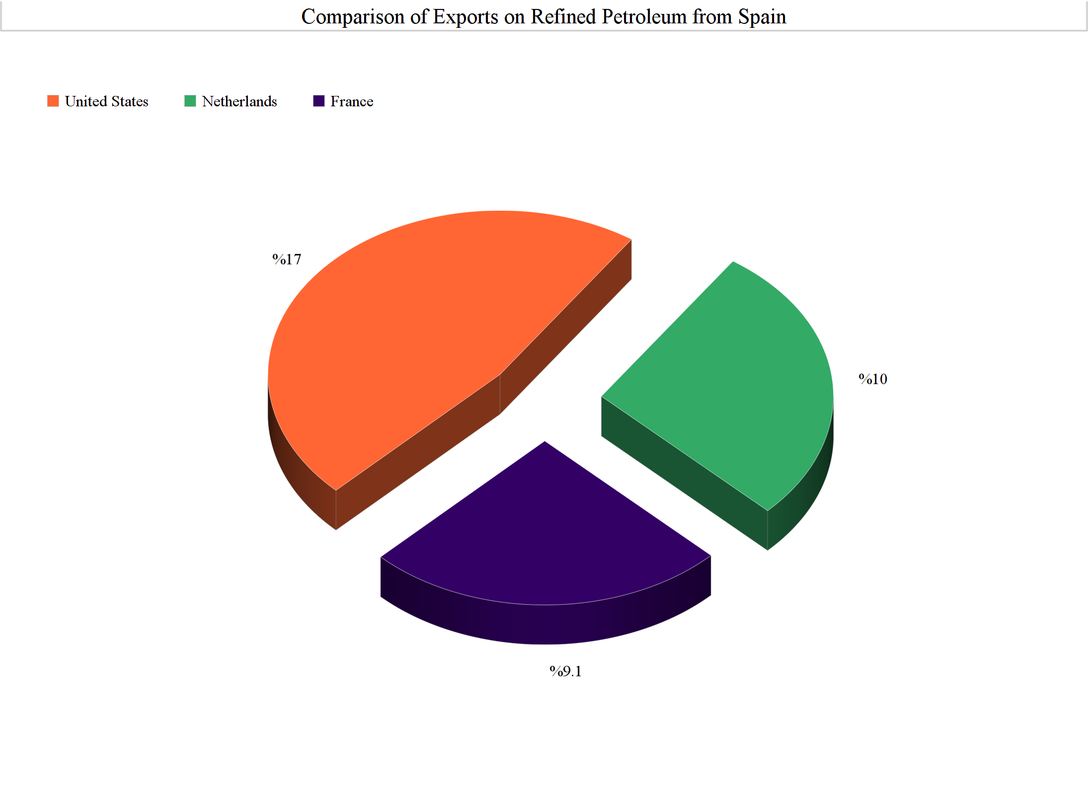
In contrast to many of their export market destinations, which are predominantly European countries, Spain exports the largest amount of its refined petroleum to the United States (17%), with the Netherlands (10%) and France (9.1%) being the next biggest destinations.


Friday, January 11, 2019

Measurement- While- Drilling (MWD)

Until the 1980s it was difficult for the drill operators to know what was going on with the drill bit as the hole was being dug. Even after the innovation of Seismic imaging operators are still facing the issues. This problem is overcome by Measurement – While -Drilling (MWD) technology.

MWD allows operators to receive real-time information on the status of drilling, as well as the ability to steer the well in other directions. It relates information such as gamma rays, temperature, and pressure, as well as the density and magnetic resonance of the rock formations. This serves a myriad of functions. It helps operators drill more efficiently while preventing blowouts and tool failures. It also helps operators show that they're not drilling into unauthorized areas.
What’s perhaps most amazing is how this information is transmitted up to the surface. Because it isn’t practical to string wire or cable down the well from the surface to the drill bit, MWD instead relies on mud pulse telemetry. A mud slurry that is sent down into the well to carry debris back up (through the outer column of the well) provides a convenient acoustic channel to send mud pulses up in a binary code that is decoded on the surface.

Friday, December 28, 2018

Seismic Imaging

Oil Companies have to spend a lot of money on digging oil. They don't like to waste their time and money on an unproductive spot. There are so many failures in spotting the oil surface.
Seismic Imaging is one of the most important innovations in Oil Exploration helps in reducing the number of unproductive wells and useful to find productive wells.
                            
In the seismic imaging process, an energy source such as a vibrator truck sends sound waves deep into the earth. This relies on the idea that sound bounces off and travels in different ways. Special devices called geophones are positioned on the surface, which receives the sounds that bounce back up and send the information to recorder trucks.
Engineers and geophysicists study the recorded sound waves to interpret what kinds of layers of rock formation lie in that location. This way, they can construct 3-D images of what lies under the surface.

Thursday, December 13, 2018

History of OIL

Before the discovery of oil, people used Wood and Coal. People burned wood for Cooking, Warmth and also used as a building material. Wood is reminded as a global fuel for centuries.
In the 18th century after the invention of Steam Engines coal comes into the picture. Steam Engines can be powered either by wood or coal. Comparatively, with wood, coal became the most preferred fuel because coal produced 4 times energy as much energy as the same amount of wood and was cheaper to produce, easier to distribute. Coal has massive growth in the scale of industrialization.                                                     
The oil had been discovered by Chinese in 600 B.C and transported in pipelines from bamboo. However, Colonel Drake's heralded discovery of oil in Pennsylvania in 1859 with a well drilled just 69.5 feet deep. The earliest exploration companies began seeking oil for refining into a newly invented lamp fuel called kerosene. This "rock oil" fuel was cheaper than Whale oil and far safer than the more popular but explosive fuel, camphene and the Spindle top discovery oil in Texas in 1901 set the stage for the new oil economy.
Early energy issues included the need for an infrastructure for producing, storing, transporting oil and natural gas. As discoveries grew, the rush for "black gold" resulted in complex economic issues on a national scale, including wasteful over-production, sudden collapses of oil prices, questionable stock promotions and frequent boom and bust cycles.

Friday, December 7, 2018

Hydraulic Fracturing

Hydraulic Fracturing developed in 1940. It came into application in 1950.
Hydraulic Fracturing treatment is used to achieve adequate flows in Shale gas,
Tight gas, Tight oil, and Coal Seam gas wells. Some hydraulic fractures can form naturally in certain veins or dikes.
In Tight Reservoirs the rocks containing the oil don't have large pores. The oil flow from the rocks is weak and drilling a simple well into the rock won't get much of the oil out.
So to take oil from this Tight Reservoirs and Shale gas Hydraulic Fracturing is used. In the Hydraulic Fracturing, they inject a high-pressure injection of 'Fracking Fluid' like water, containing sand or other proppants suspended with the aid of thickening agents into the wellbore to create cracks or fractures in the rock formations. Fractures can extend hundreds of feet long. To keep the fractures from closing again, drillers send down a proppant, which is a mixture of fluids, sand, and pellets. These allow the oil to flow more freely from the rock.

Monday, December 3, 2018

Offshore Drilling and ROVS(Remotly Operated Vehicle)


As the oil and gas industry moves to a more subsea environment, ROVs will become an even more important tool in drilling, development, and repair offshore. In fact, some ROVs are being built to work on specific subsea developments, with manipulators and tools designed for work on equipment in a precise field. In this case, as the subsea architecture is being designed, the ROV that will handle the subsea work is taken into account, as well, ensuring that all tasks at hand can be managed by the ROV.

One of the technologies that spurred the development of offshore drilling was ROV (Remotely Operated Vehicle). In the 1970 Oil industry adapted ROV for drilling. Diving in deep water is dangerous for people. So the Military is using this ROV technology to retrieve the lost equipment underwater.


Innovation R&D | Robotic Drilling System | oil and gas industry

If you are interested in presenting a talk at the conference ( World Congress on Petrochemistry and Chemical Engineering ), please submit ...